Old Hyde

Old Hyde
Pole Bank 1910 ----------------------------------------------------------Town Hall 1937 --------------------------------------------- Cenotaph 1990
Showing posts with label Houses. Show all posts

Sunday, 1 July 2012

The Lumn


This image is from The Annals of Hyde according to which
Probably the oldest house in Hyde is "The Lumn" homestead of the Shepleys. Purchased in 1612 from Sir Uryan Legh, of Adlington, "The Lumn" estate became the property of Richard Shepley, whose direct descendants continue to hold it. This estate is said to have received its somewhat uncommon cognomen from the fact that the homestead erected thereon was then the only house near that boasted a chimney. On that account it was named "The Lumn."

The Lumn was located in front St Thomas Church bordered by Tom Shepley St, Orchard St and Lumn Road.

A contribution to the CDPB theme day, Chimneys.

Thursday, 21 July 2011

Hoviley Brow before the motorway came


This photograph first appeared here in August 2007.

It shows Hoviley Brow, near the Dye Works which is now home to ABC Wax.

The houses were demolished by the 1970s and the ground covered by the M67 Motorway.

About the only thing still standing is the factory chimney. It would have been dirtier then and not carrying mobile-phone relay masts!

See how it looks now on Hyde Daily Photo.

Tuesday, 11 January 2011

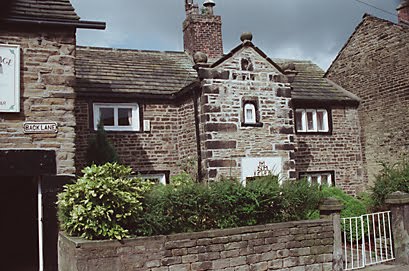
Old Post Office Farm


This photograph, © Frank Bennett, first appeared on the Images of England site and is republished here with permission.

Date Photographed: 02 September 2000.

The official description is
LONGDENDALE BACK LANE SJ 99 NE (west side) 4/43 No. 2 (Old Post 1.11.66 Office Farm) G.V. II Includes left hand bay only of No. 50 MARKET STREET (west side) which was formerly part of the same house. House, "NWM 1694" (Nicholas and Martha Wagstaffe) on door lintel. Squared coursed rubble with graduated stone slate roof and brick stack. 2-bay baffle-entry plan with 2 storeys, a 2- story porch,one room in depth and a slightly later wing added to rear. Stone plinth and quoins. Symmetrical facade with 5-light house-part window (with 3 mullions removed) and three 3-light windows (one with mullions removed) all with double-chamfered stone mullions. The central porch has an off-centre chamfered door surround, a round-headed first floor light, an owl hole and dove holes, and coped gable with kneelers and ball finials. Central ridge chimney stack. Rear has 2 windows with mullion removed. Round- headed attic gable light. Interior has a wattle and daub timber-framed partition on 2 floors.
See my own photograph on Hyde Daily Photo.

Wednesday, 5 January 2011

4 Back Lane


This photograph, © Frank Bennett, first appeared on the Images of England site and is republished here with permission.

Date Photographed: 02 September 2000.

The official description reads
LONGDENDALE BACK LANE SJ 99 NE (west side) 4/44 No. 4 20.4.77 G.V. II House now shop. C18. Squared rubble, graduated stone slate roof and brick stack. l-bay, double-depth with 2 storeys. Stone plinth. Door to right with square-cut stone surround, window to left and small window with glazing bars on first floor. Gable chimney stack. Included for group value.
See my own photograph on Hyde Daily Photo.

Monday, 20 December 2010

Mottram School House


This photograph, © Frank Bennett, first appeared on the Images of England site and is republished here with permission.

Date Photographed: 02 September 2000.

The official description is
LONGDENDALE CHURCH BROW SJ 99 NE (west side) 4/48 No. 6 20.4.77 (School House) G.V. II Schoolmaster's house. Dated 1862. Rock-faced stone with ashlar dressings and graduated stone slate roof. 3 bays, single-depth with 2 storeys. 3, 4 and 5-light chamfered mullion windows with hoodmoulds on ground floor, none on first. Tudor style door in bay 3 with "manners maketh man" inscribed above in Gothic script. Bays 1 and 2 are recessed the eaves being supported on slender timber columns with arch bracing. A plaque in bay 3 reads "Come ye Children: Harken unto me: I will teach you the fear of the Lord: The fear of the Lord is the Beginning of Wisdom: Bring them: In the nurture and admonition of the Lord: Anno Domini MDCCCLXII". Coped gables, 2 ridge chimney stacks and mullion windows to rear.
See my own photograph on Hyde Daily Photo.

Monday, 26 July 2010

Hyde Hall in 1794


Hyde Hall in 1794

According to Pigot & Company's Trade Directory of 1834
Hyde Hall, the seat of Hyde John Clarke, Esquire, is a building of some considerable antiquity; recent improvements have deprived the exterior of its ancient appearance, but a greater part of the interior is in its original state. It is pleasantly situated on the river Tame, but the rapid progress made in manufacture, and the introduction of machinery to such a vast extent and power has materially deteriorated from the beauties of the adjacent scenery.
Hyde Hall (not to be confused with its surviving namesake in Denton) was situated on the left bank of the river Tame, a short distance to the east of Clarke's Bridge over the river (not to be confused with Captain Clarke's Bridge over the Peak Forest Canal). The drive to the hall was off Mill Lane, just above the bridge. On the opposite side of the river in Glass House Fold, Haughton, Lancashire, the Clarke family worked coal pits where a company of refugee Flemish glass makers and blowers had settled during the reign of Elizabeth I.

Around 1793, George Hyde Clarke built Clarke's Bridge over the river Tame at the bottom of Mill Lane. He did this in order to improve the supply of coal into Hyde and also in anticipation of the opening of the Peak Forest Canal, in which he was a major shareholder. The lower level of the canal opened in 1799/1800. However, this single-arched bridge was seriously damaged, and possibly destroyed, by the great flood that occurred on the 17 August 1799. (The present Mill Lane bridge over the River Tame was erected in 1895).

Notwithstanding this, a tramway was constructed from Glass House Fold, over this bridge, or its successor, along the side of Mill Lane for a short distance and then up the field by Hyde Hall to a wharf on the canal where coal from the pit, carried in horse-drawn waggons, was loaded into boats. The date of abandonment of this pit is unknown but there is no reference to it in the 1888 Distance Table of the Peak Forest Canal.

The original Hyde Hall, dating from the seventeenth century, was considerably altered in the mid eighteenth century creating the Georgian country house pictured above. The hall was demolished in 1857, but the farm building, on the left in this picture, survived into the twentieth century. The site of the Hall was purchased by Hyde Corporation in 1924.

A map dated 1882 appears to show Hyde Hall itself occupying the land that is now Kingston Recreation Ground. Hyde Mill is shown adjacent to the river in an area now occupied by a Fairhaven caravan park.

A fuller account of the Clarke Family of Hyde can found at http://www.pittdixon.go-plus.net/clarke/clarke.htm

Recent photographs of Kingston Recreation Ground can be found on Hyde Daily Photograph and also on Hyde DP Xtra.

I'm indebted to Paul Hyde-Clarke for bringing some of this material to my attention.

Tuesday, 8 June 2010

Clock Tower on Stockport Road


Janet Howie sent me this old photograph of houses and a clock tower on Stockport Road, Gee Cross.

I'm informed that these once stood on the site now occupied by the Smith Knight Fay car dealership at the top of Apethorn Road.

You can see the current day photo on Hyde Daily Photo.

Tuesday, 20 April 2010

Rowbotham Street 1984


Photograph © 1984, 2010 Janet Howie.

This is the top of Rowbotham Street at its junction with Stockport Road in 1984.

See how it looks now on Hyde Daily Photo.

Look further down the street on Hyde DP Xtra.

Wednesday, 23 December 2009

Travellers Call No More


When I published a 100 year old photograph of the Travellers Call, I was asked if I had a photograph of the modern building.

Well I've not yet had the chance to get up there and take a recent view. I do however have this photograph taken by Janet Howie in 1982. So far as I recall it looks much the same now.

Tuesday, 3 November 2009

Diamond Row


Janet Howie sent me this photograph of the cottages known as Diamond Row. I'm not sure of the age of this; I'd guess circa 1920.

They used to stand on the corner of Stockport Road and Back Bower Lane.

The Diamond Row reservoir, which was behind them, has been covered and is now an open space.

Wednesday, 14 October 2009

The Lumn


This image is from The Annals of Hyde according to which
Probably the oldest house in Hyde is "The Lumn" homestead of the Shepleys. Purchased in 1612 from Sir Uryan Legh, of Adlington, "The Lumn" estate became the property of Richard Shepley, whose direct descendants continue to hold it. This estate is said to have received its somewhat uncommon cognomen from the fact that the homestead erected thereon was then the only house near that boasted a chimney. On that account it was named "The Lumn."
Precisely where it was located I don't know but the name survives in Lumn Road which runs from Mottram Road to Stockport Road, a length of which can be seen on Hyde Daily Photo.

Thursday, 1 October 2009

Contrasts on Joel Lane


This is another photograph from Janet Howie showing Joel Lane in 1983.

The white stone cottage was built in 1738 and whilst it has been modernised it still stands as can be seen from the photograph I took in 2008 which you can view on Hyde DP Xtra.

The later brick-built house below it in Janet's photograph has however been demolished and replaced by a newer property although I don't have a photo of that to show you.

The CDPB theme today is "Contrast": Click here to view thumbnails for all participants.

Tuesday, 22 September 2009

Gower Hey Bank in the 1950s


Gower Hey Bank, a large house at the end of Osborne Road, was once the home of Thomas Middleton, one time Mayor and author of the Annals of Hyde.

More recently in the 1950s it was the home of then teenager Denys Meakin who emigrated to Canada in 1959 and who has kindly sent me this photograph.

Today the site contains a small estate of modern houses named Gower Hey Gardens which back onto Gower Hey Woods.

You can see the fence and banking on Hyde Daily Photo.

Wednesday, 22 July 2009

Dr. Beecroft's Surgery, c.1910


This photograph of a house on Church Street, c.1910 was sent to me by Yvonne Michelle from Arizona.

She is the great-great-grandaughter of Dr. Samuel Beecroft and Sarah Bloor and the great-granddaughter of Arthur Beecroft and Edith Mary Clegg. The Beecrofts were doctors and the house doubled as their surgery.

When Arthur Beecroft died at sea, while working as a ship's doctor, his wife Edith Clegg Beecroft sold the home and moved to Australia. She sent Yvonne's grandfather (11 years old at the time) to live with relatives in Texas, so he'd have better opportunities in America. Yvonne thinks her grandfather's nanny bought the house and was living there when her parents visited in 1974.

A photo taken by her mother in 1974 can be seen on Yvonne's blog C'est la vie. Update That link is now dead.

For a 2009 photograph and more on the subsequent history of the house, see Hyde Daily Photo.

Wednesday, 28 May 2008

Sundial Cottage


Dated 1697, this cottage on Pudding Lane had a stone sundial on its front.

The photograph was taken around 1905.

Although a listed building, it was badly vandalised and eventually demolished. Only the names of two terraces, Sundial Walk and Sundial Close on the Hattersley estate now commemorate the site.

My other ABC Wednesday S posts this week are ~~ St Michael's & All Angels at Hyde Daily Photo ~~ Scream at Ackworth born, gone West ~~ South Pier at Sunset at Sithenah

To visit more ABC-Wednesday posts go to Mrs. Nesbitt's Place.

Wednesday, 23 January 2008

Godley Hall at Godley Hill


This picture by Frank Bennett and reproduced here with his permission, first appeared on the Images of England site.

This picture was taken in August 1999. A grade II listed house which is now a public house. "ICE 1718" on door lintel. Squared rubble with graduated stone slate roof and brick stacks. 3-bay 2-storey plan, the original door position, (now on the rear) suggests a baffle-entry. A 2-storey stair wing at the rear (now the front) is used as a porch and C20 additions have been added to each end. 3 window openings on each floor totalling three 2-light double-chamfered mullion windows (2 with hoodmoulds and all with mullions removed) 2 plain casement openings and a round-headed light. The porch has 2 similar round-headed lights, projecting plinth, an off-centre door, and a coped gable with kneelers and a ball finial. 2 ridge stacks and a later door to the right. The blocked door to the rear has a moulded surround and finely carved dated lintel. 3-light double-chamfered window and a single storey wing of a slightly later date. Interior much altered.

Friday, 18 January 2008

Longdendale Minature Castle


This picture by Frank Bennett and reproduced here with his permission, first appeared on the Images of England site.

The farmhouse and cottage on Matley Lane were photographed in May 2000.

It is late C18 but with additions, including the facade of mid C19. Hammer-dressed stone and coursed rubble with C20 clay tile and graduated stone slate roofs. 3 bays, 2 storeys apart from a 3-storey tower in bay 1. Projecting plinth and castellated parapet. Bay l has flat-faced 3 and 2-light mullion and transom windows, projecting corner piers, castellated parapet and band. Windows with stone surrounds to bay 2 which has a square-cut door surround. Bay 3 which has a higher parapet has an engraved stone reading "Longdendale Miniature Castle".

Saturday, 22 September 2007

Gibraltar Mill & Gibraltar Row


Gibraltar Mill lay by the River Tame between Apethorn and Haughton Dale. It was demolished in the 1960s.


This row of houses has also long since gone.

Sunday, 9 September 2007

Hearse House


This picture by Frank Bennett and reproduced here with his permission, first appeared on the Images of England site.

Photograph taken August 1999.

Hearse house next to St. George's Church on Wood End Lane is a Grade II listed building. 1841 on keystone. Hammer-dressed stone with ashlar dressings and slate roof. Gable facing road and having large double doors within a Tudor-arched surround with chamfered rustication and a skull and cross bones keystone. Coped gables and eaves bands.

These days it seems to be used for storage. This Eagle Lectern was found there before being put on display at the recent Heritage Open Day.

Wednesday, 22 August 2007

Apethorne Farmhouse


This picture by Frank Bennett and reproduced here with his permission, first appeared on the Images of England site.

This was taken in May 2000 and shows the farmhouse on Apethorne Lane.

Originally 15th century but with external walls and other features of the C17 to C19. Cruck-framed with brick and squared rubble walls and a graduated stone slate roof. Originally a 4-bay cruck-framed open-hall house (probably a long-house) but with a floor inserted in the C17 and other alterations during conversion to cottages.

The elevation consists of a small gabled wing in bay 1, and a second bay both of which are in stone. The other 3 bays are in brick and have 3 doors relating to their use as a shippon. One ridge chimney. The east elevation, again with 3 bays in brick and the remainder in stone has 3 dormer windows rising from the eaves, one of them gabled. The gable onto the road has one ground floor window and a sash window above.

It is an important example of an early house-type few of which remain in Greater Manchester.
Related Posts with Thumbnails